
Quadhelion Engineering
A Primer on Blockchain focusing on fundamental Cryptography as it applies to Bitcoin
Chapter 1
Cryptographic Hash Functions
-
Mathematical Hash function:
-
Takes any string as input
-
Fixed size output (We’ll use 256 as does Bitcoin [$BTC])
-
Efficiently Computable
-
-
Security Properties of Cryptographic Hash Functions
-
Collision free
-
Hiding
-
Puzzle-Friendly
-
Collision Free
| Perspective |
Mathematical probability for collision
For i-th element, the probability of total number of collisions = (i-1)/T as there are i-1 previous elements which can collide and T is the total number of possible values, where M is a given hash value *
| Bits In | Elements for 1st Collision |
|---|---|
8 |
23 |
16 |
362 |
32 |
92,682 |
64 |
6,074,001,000 (6 Billion) |
128 |
26,087,635,650,665,564,424 |
256 |
4.8 x 10^38 |
Hashes are NOT Collision Free and People DO find them
| In 2008, the CMU Software Engineering Institute declared MD5 "cryptographically broken and unsuitable for further use" |
| SHA-256 is under heavy fire from AI on High Performance Computing Grids and Quantum Computing. FERMILAB, CERN, IBM, or Microsoft may already have the hardware capability. |
-
How to find a Collision
-
Try 2^130 randomly chosen inputs
-
99.8% chance that two of them are the same output from different input
-
-
This works no matter how long H (Hash function elements) are but it takes too long to matter for regular computers
"If every computer ever made by Humanity was computing since the beginning of the Universe up to now, the odds they would have found a collision is so infinitesimally small it would be like the chance of being hit by an asteroid in the next two seconds."
-
Brute forcing is interminably slower than Birthday Attacks.
-
No H (Hash function) has ever been proven to be collision free
"We choose to believe that some hash functions are collision free"
-
Many hash functions have been broken and are insecure
-
We will go forward assuming our hash function is collision free.
Hashes as message digests
-
Hash as a pointer to unique information relayable through a network
-
Useful because the hash is small
-
Compare 256bit hashes of files instead of files
Hiding
-
Infeasible to know the content of the input string being hashed from the hash unless input set of elmenents are low and can be recreated and matched with the hash.
-
Thus, inputs must be broad and as random as possible
-
Done by prepending high-min-entropy r (Random) to the input $$H(r | x)$$
Application Hiding: Commitment
| A commitment scheme in the context of Bitcoin allows a sender to commit to a value while keeping it hidden from the receiver, with the ability to reveal the value later. This process ensures that the sender cannot change the committed value after it has been revealed, a property known as binding. Additionally, the receiver should not be able to determine the committed value during the commitment phase, known as the hiding property |
(com, key) --> commit(msg)
match --> verify(com, key, msg)
-
Sealing transactions
(com, key) -→ commit(msg) -→ publish: com -
Opening transactions
Publish:key, msgwhere anyone can useverify()to check validity
Commitment API
-
Commitments are binding
Where H is a hash function, key or k is a random 256bit value, com is transaction data, | is concatenation
commit(msg) = H(key | msg), key)
verify(com, key, msg) = (H (key | msg) == com)
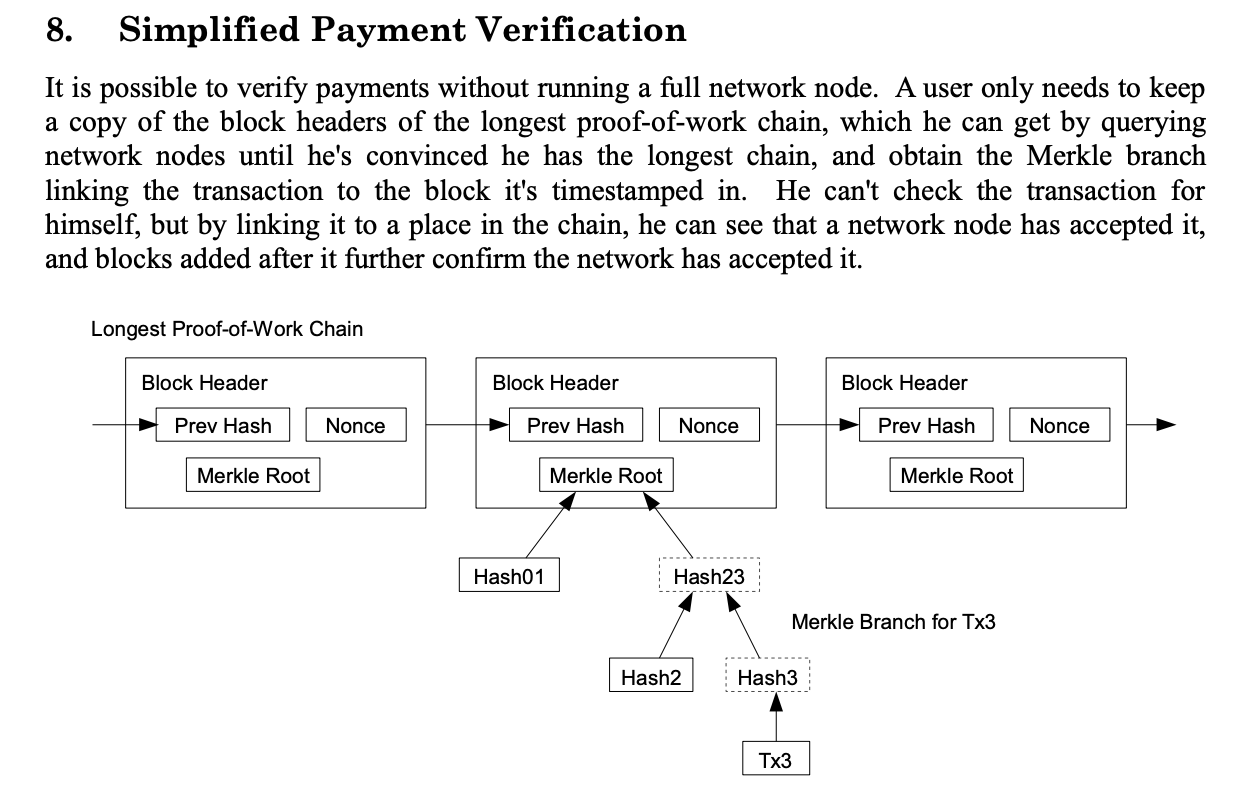
| From the Whitepaper |
Puzzle-Friendly
-
Property implies that no solving strategy is much better than brute-forcing commitments
Bitcoin Uses SHA-256
Chapter 2
- What is a Hash Pointer?
-
A cryptographic hash that references another data storage location
Functions
-
Retrieve stored data
-
Verify Integrity
-
Consists of two data stores: hash + pointer
| You can Build Data Structures with Hash Pointers on top of another structure type like Merkle Trees for example |
Advantages Of Merkle Trees
-
Many times, one hash
-
Membership verification of data block in O(log n) time/space
-
SORTED Merkle Tree can verify non-membership in O(log n) time/space
-
Showing items before and after the non-existent data block
-
Members before and after are consecutive
-
-
-
Can use Hash pointers in any data structure that doesn’t cycle
Chapter 3
Digital Signatures
Schema
-
pk = public key
-
sk = secret key
-
m and/or M = Message
-
sig = cryptographic signature we are talking about
Requirements
-
Cannot be forged
-
Like PGP, only one signer per key
-
Keys are tied to signer/user by another system
-
Usually the first to announce the public key
-
-
-
Open Verification
-
verify -→ public key + message + signature
-
-
Verification of signer and message go togther
-
Per message authenticity
-
Public Key
-
-
-
In totality constitutes a signature scheme
-
Cannot be forged
Characteristics
And I’ll just point out here that attacks on the source of randomness are a favorite trick of intelligence agencies.
https://www.coursera.org/learn/cryptocurrency/lecture/bx6si/digital-signatures
-
Minimizing message size lends itself to send hashes of messages instead of messages
| Signing a hash pointer creating a signature of that pointer covers the whole structure. |
| Using that tip, signing the last block in a chain would enumeratively digitally sign the contents of all prior blocks. |
Specifications of Bitcoin
Bitcoin’s choice/implementation for Signature Algorithm is Elliptic Curve Digital Signature Algorithm (ECDSA) — DETAILED CRYPTO REFERENCE which is a United States Government Standard
| The Current Director of the National Institute of Science and Technology is temporarily a Lawyer named Craig Burkhardt |
"6. The Elliptic Curve Digital Signature Algorithm (ECDSA) — This standard (FIPS 186-5) specifies (in Section 6.4) methods for digital signature generation and verification using the Elliptic Curve Digital Signature Algorithm (ECDSA). Specifications for the generation of the domain parameters used during the generation and verification of digital signatures are included in SP 800-186, Recommendations for Discrete Logarithm-Based Cryptography: Elliptic Curve Domain Parameters [5]. ECDSA is the elliptic curve analog of DSA. ECDSA keys shall not be used for any other purpose (e.g., key establishment). Deterministic ECDSA (Section 6.3.2) is a variant of ECDSA, where a per-message secret number is a function of the message that is signed, thereby resulting in a deterministic mapping of messages to signatures. This variant does not impact the signature verification process. IETF RFC 6979, Deterministic Usage of the Digital Signature Algorithm (DSA) and Elliptic Curve Digital Signature Algorithm (ECDSA) [4], describes this deterministic digital signature generation procedure. The use of deterministic ECDSA may be desirable for devices that do not have a good source of quality random numbers. For signature schemes, secrecy of the private key is critical. This is especially true with deterministic signature schemes, which return a unique signature computed from the hash of the private key and the message. Care must be taken to protect implementations against attacks, such as side-channel attacks or fault attacks [17, 18, 19, 20, 21, 22]. A cryptographic device may leak critical information with side-channel analysis or attacks that allow internal data or keying material to be extracted without breaking the cryptographic primitives. It is also important to verify the correctness of group arithmetic computations for ECC implementations. These types of attacks may be of particular concern for hardware implementations of deterministic signature schemes, as well as embedded or IoT devices and smartcards."
You probably leaked your private key
Chapter 4
Public Keys as Indentities
-
Only one person knows the secret and that is the identity for them which the public can verify
-
Can be Anonymous
-
Decentralized identity management
| In Bitcoin, an address is an identity |
You can create an identity by typing the following into a shell:
ssh-keygen -f ~/.ssh/MY-NEW-IDENTITY -C "your@email.address" -t ECDSA -b 521
Chapter Quiz
If you generate numerous identities (public keys) for yourself and interact online using those different identities, what might happen? (Check all that apply)
-
Others might be able to take over your identities if your randomness is bad
True
-
Others may be able to link your identities because public keys generated on the same computer look similar
False
Others may be able to de-anonymize you by analyzing your activity patterns True
Chapter 5
A simple sample cryptocurrency
SimpliCoin Where H is a Hash Pointer
-
SimpliCoin can create coins
CoinID -
SimpliCoin signs transactions
-
Sign coins
CoinID{pk} -
SimpliCoin signs to Bob
CoinID{Bob} -
CoinID{Bob} -→ H() -→ SimpliCoin sig -
Transaction from CoinID{Bob} to CoinID{Alice}
CoinID{Alice} H() -→ CoinID{Bob} H() -→ CoinID{SimpliCoin}
Software Method - AIM
Three is simple and robust enough which is our AIM to never fail
-
Account
-
Features
-
Main classes
-
-
Problems
-
-
Identify
-
Structures
-
Modularize core components
-
Enables transition from modularized existing replacements to whole replicable systems of core modules
-
-
-
Dataflow
-
Chokepoints
-
Databases
-
Networks
-
-
-
Manage
-
Goals
-
Formats
-
Chapter Quiz
In ScroogeCoin, you have ten coins each of value 3.0. You’d like to transfer coins of value 5.0 to your friend. This requires:
-
One transaction, one new coin created, and one signature
False
-
One transaction, two new coins created, and two signatures
True
-
Two transactions, two new coins created, and four signatures
False
-
Two transactions, one new coin created, and two signatures
False